About Monique Walsh

Monique Walsh is a writer, collaborator, and facilitator. She currently holds the position of Communications Officer at The Banff Centre and is pursuing a Master's degree in Adult Education. Walsh is inspired by the magic of the mountains and the creative people that surround this place.
Archive by Author

Tanya Evanson: “the griot of all time”

LA130405_DSC2517

Spoken Word director and artist Tanya Evanson, guiding a collective breath in The Club. Photo: Meghan Krauss.

“So how does someone get started as a Spoken Word artist?” I asked Tanya Evanson, the new director of the Spoken Word program here. She explains that it’s not really a choice, but a calling. “Leonard Cohen said it best, ‘poetry is not an occupation. It’s a verdict’. I can’t just say, step one – buy a journal.” As director, Evanson designed the program for the 15 Spoken Word artists here to emphasize the “timelessness of art”. To do this she selected diverse faculty, each bringing different skills and a unique background to the program.

“There’s  Jean-Pierre Makosso, a griot from the Congo – the original storyteller around the fire, but not just the storyteller. The musician, the dancer, the singer, the ceremony participant, the genealogist, and the librarian.” Then there’s D’Bi Young, a Jamaican dub poet. “She’s very much on the spiritual side,” Evanson says. The other two faculty are what Evanson refers to as more “futuristic.” Christian Bök is an experimental sound poet (he won the Griffin Prize for Eunoia). “He’s interested in vocalization and all the things you can do with that instrument - the mouth.” Alexis O’Hara‘s specialty is media and working with technology.

Continue Reading →

Comments { 0 }

Eight things I learned about the art of route-setting in a climbing gym

Mark Kriddle on the newly route-set Sally Borden climbing wall. Photo: Meghan Krauss.

Mark Kriddle on the newly route-set Sally Borden climbing wall. Photo: Meghan Krauss.

Have you ever been in a climbing gym and gotten stumped at a particular spot along the route? The thought that usually crosses my mind as I cling to the wall, knuckles slowly turning white is, “What kind of perverted person would design something like this?” How (insert *!@#  here) am I supposed to switch my hands? Or rotate my foot? Or whatever move the hold in front of me is prompting me to do, but seems impossible at this very moment. I just had to meet the masterminds behind the route-setting here at the Sally Borden Fitness and Recreation Centre and give them a piece of my mind - I mean ask them a few questions. What I discovered was that route-setting is more of an art then I had realized.

Here are the eight things I learned about the art of route-setting:

#1      Everyone has their own way of doing it.

With so many different climbers, it’s important to have different route-setters with different styles and inspiration. As Chris Neve tells me you need to create “enough variety for people to really be tested on.”

For Chris, “I usually think about a grade and try and find the holds that match that grade. I like to get one kind of move that I want to do in a route. Sometimes that will be at the bottom, middle or at the top. I’ll make sure that move happens and I’ll just build around it.”

Mark Kriddle, on the other hand, “work(s) mostly from the bottom up. Normally I’ll start with hand holds first so I’ll start taping where I want the hand holds.”

As for Matt Wade, he “personally lay(s) the entire sequence down on the floor and then put(s) the route up in one big shot.”

#2      Inspiration comes from all sorts of sources.

These guys set approximately six new routes every week, which can prove challenging to keep the inspiration flowing. As Matt tells me, “I get a lot of inspiration from climbing outside or watching competition videos.”

As Chris said, “You find a pretty cool move and you try and replicate it in the gym because you think other people will like it as well. Sometimes when we have our bucket of holds, you’ll just see a hold you want to use.”

Continue Reading →

Comments { 0 }

Joseph Boyden: fiction & fact

Joseph Boyden soaking in Banff in front of his Leighton Artists' Colony studio. Photo: Kim Williams.

Joseph Boyden in the Leighton Artists’ Colony. Photo: Kim Williams.

Earlier this week, Joseph Boyden opened his public reading here by confiding to the audience that he wasn’t supposed to read from his new work, but he was going to anyway. Then he dropped us right into a graphically violent scene involving his three protagonists, a scene he describes as, “a car chase from the 1600s.” The Orenda, Boyden’s newest novel, is set in the 1600s at the intersection of First Nations and Canadian history. The book is expected to be out in September, and I know that everyone who was in that room with me will want to know what happens to the three characters we were briefly introduced to: a Haudenosaunee, a Huron-Wendat, and a Jesuit.  

Boyden won the Giller Prize for his second novel, Through Black Spruce, and he’s been in our Leighton Artists’ Colony this week on a Paul D. Fleck Fellowship through Indigenous Arts, editing his new novel. I met him the day after his reading. For one thing, I wanted to know what he felt standing in front of us and reading from The Orenda. “It was fun to read but it was a little nerve-wracking,” he tells me.  ”You feel like a brand new writer again. Despite any little success I might have had, it’s all new again.” He’s clear that The Orenda stands alone (it’s not the third book in the trilogy that includes Three Day Road and Through Black Spruce) though fans may find an interesting connection to his previous novels.

Continue Reading →

Comments { 0 }

Fred Wah: On the literary edge

Fred Wah, Parliamentary Poet Laureate and faculty with In(ter)ventions, presenting in The Club. Photo: Meghan Krauss.

Fred Wah, Parliamentary Poet Laureate and faculty with In(ter)ventions, presenting in The Club. Photo: Meghan Krauss.


Accomplished writer. Parliamentary Poet Laureate. In(ter)ventions faculty. Fred Wah and I sat down over lunch to chat mostly about that last role. This is the fifth year Fred’s been involved with In(ter)ventions, and when I think about that program title I wonder what, exactly, are they intervening?

After our chat, I’ve discovered that In(ter)ventions is a literary arts program for experimental approaches to writing. It’s not as simple as moving print into a digital form, though that’s part of the conversation. Instead, it’s really about taking an interdisciplinary approach to producing text, and finding new ways to tell stories. In fact, as Wah tells me, he got interested in the program because of the interdisciplinary nature of his own work.

Wah has been coming to The Banff Centre since the 1960s, and he’s taken many visual arts programs, including one that partnered Mexican and Canadian poets and photographers. That collaboration led to his book Sentenced to Light. But, as he says, “In(ter)ventions is really the first time Banff has approached that cross-disciplinary context from a literary point of view.”   Continue Reading →

Comments { 0 }

Cellofest captured on camera

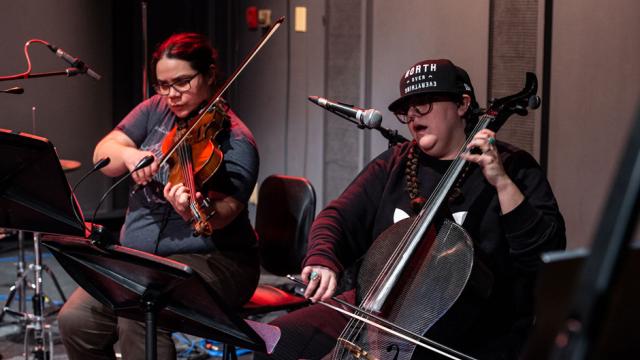
Every year this annual Instrument Fest rotates between a focus on the cello or a focus on the violin. This February we had 25 participants take part in Cellofest, spending a long weekend here at the Centre. The participants, mostly young emerging artists, were excited to attend this specialized training opportunity, which combines master classes, ensemble coaching, and supervised rehearsals. Below are a few snapshots that capture Cellofest in action. 

Comments { 0 }

Where ART + IDEA intersect: Merging digital media with performance

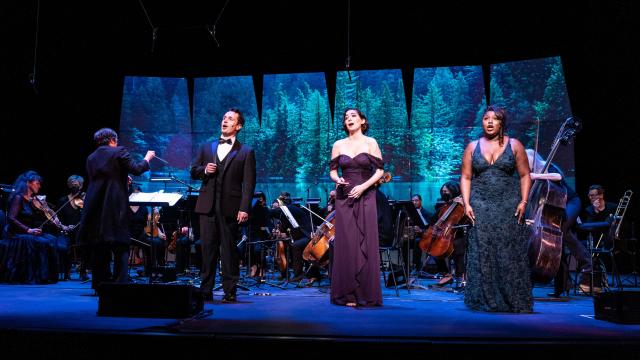
Digital flames paint Don Giovanni’s demon lovers during the opera’s final scene. Image: Meghan Krauss.

Picture this.

A lone actor on stage, the video game world of Froggy projected behind him. As he begins to run, his loosely choreographed movements interact with the citybuildings exploding around him. The actor turns left, momentarily saving himself, and the audience, from a falling pillar.

Or this.

It’s the final scene of Mozart’sclassic opera Don Giovanni. Instead of imagining Don Giovanni’s descent into hell, the entire stage, including all the singers, bursts into flames and is consumed by a projected inferno.

Both are examples of The Banff Centre’s IDEA initiative in action.

The IDEA initiative explores the integration of digital media projection into the world of theatre. Consisting of four themes: Interaction, Design, Experience and Audience, IDEA is a multiyear applied research initiative focusing on how, why, and where of using digital media to enhance storytelling.

Nicholas Mills, director of Digital Media Research at the Centre, describes 2012, the first year of the IDEA project, as the “possibility year.” The year began with a think tank exploring the major challenges in the field, and culminated in the first annual IDEA Summit in October. Continue Reading →

Comments { 0 }