People’s Choice Award: “I’d like to thank my dog.”

It’s official: It’s not just me who is completely smitten with Australian adventurer Tim Cope. Recipient of the 2011 Banff Mountain Film Competition People’s Choice award for his film On the Trail of Ghengis Khan, tonight he took the stage:

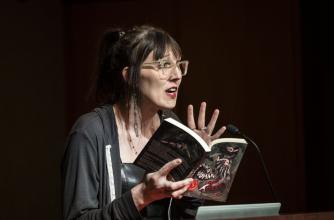
Tim Cope presents his three-hour film about his three-and-a-half years of travel from Mongolia to Hungary. Photo courtesy of The Banff Centre.

“There are so many people I’d like to thank for this film – it’s been a six or seven year project. And there are lots of people who stood by the film. But apart from my family, and the 90 or 100 families I stayed with during the journey who made it possible, I guess I’d like to take the chance to say thanks to my horses, the three that took me through: Ogonyok (who was so paranoid that he would bolt at the sound of his own fart), Taskonir, and one other horse … oh, I won’t repeat the name … oh, OK I will, it’s kok – k.o.k. And not to forget, a really big thanks to my dog, Tigon.”

Comments { 0 }

Brrrrrr! It’s Cold!

Cory Richards' response to winning the 2011 Grand Prize was the same as when he was on the mountain: "What the F am I doing here?"

I cannot believe that a dark, short, sort of experimental, R-rated adventure film would win this prize. – Anson Fogel

Last February, at a high camp on Gasherbrum II in Pakistan’s Karakorum Range, Simone Moro, Denis Urubko, and Cory Richards completed the first winter summit of one of the country’s 8,000-metre peaks. Until then, the mountain was an achievement that 16 expeditions over the past 26 winters had failed to bag. With shivering hands on his camera, Richards captured an immediate, personal view of an expedition that scraped the limits of endurance for all three, with days in a sheer deepfreeze, and a sudden, near-fatal avalanche on the descent. Director Anson Fogel, impressed with Richards’ handheld footage, edited the story together to create Cold, announced tonight as the 2011 Banff Mountain Film Competition Grand Prize winner and recipient of the award for Best Climbing Film. Fogel also produced this year’s Best Short Mountain Film award-winner, Chasing Water.  

“This is surreal,” Fogel said as he took the stage for the third time tonight, “I love Canada. I’m completely overwhelmed; mostly by an incredible sense of appreciation and thankfulness that I can do this for a living. Thank you to all the people who come and support not just our film, but all these small mountaineering and adventure films. None of us would have jobs if it wasn’t for you. Please keep coming.”

We were awed by this film,” said the jury, “it’s sensitivity, its humility, and its great technical prowess.”

Fogel, who attended the 2010 Banff Adventure Filmmakers workshop, says he is honoured to watch his films on the Banff screen. “Being in Banff around 300 other talented filmmakers is inspiring. You can’t help but learn from hearing and seeing how the others tell a story.” And how does Cory Richards feel about sitting through the film himself? “Uncomfortable! I know it is a beautiful piece of art, but it sucks me back to that moment. I tend to want to leave the theatre and look for someone to have a beer with!” No problem there Cory; see you in about an hour at the wrap party.

2011 Banff Mountain Film Competition Winners

Grand Prize – Cold
The Banff Centre Award for Creative Excellence – The Wolf and the Medallion
Best Film – Exploration and Adventure – Kadoma
Best Film – Mountain Culture – The Sun Behind the Clouds
Best Film – Mountain Environment – SPOIL
Best Film – Climbing – Cold
Best Film – Mountain Sports – The Freedom Chair
Best Film – Wildlife and Natural History – Broken Tail
Best Short Mountain Film – Chasing Water
Best Feature-length Mountain Film – All.I.Can
Special Jury Mention – Journey on the Wild Coast
People’s Choice Award for Radical Reels – Reel Rock: Race for the Nose

Comments { 1 }

Bridging Banff and the world

SImon, Tina, Jemima, and Nell. Just four of the many international organisers who take the Festival to more than 30 countries of the world.

Simon Piper, Tina Qian, Jemima Robinson, and Nell Teasdale are all Banff Mountain Film Festival World Tour organisers. Between them, they are responsible for taking the best of the Festival films on tour in the UK, Australia, and China.

“A friend asked me, ‘Why don’t you bring Banff Mountain Film Festival into China?’” Tina writes on the banffchina.com website; “It is this question so stunning that I nearly fall from sofa to ground.” Only two years old, the Chinese Banff Mountain Film Festival Tour is going gangbusters. It is the first foreign film festival to be approved for import by the Chinese government, and the first to show all of its films in HD. Attendance has doubled in the last year, and Tina has made the Chinese Tour her full-time job. “It is a dream come true,” she says, “bridging Chinese outdoor fans with the world.”


Comments { 0 }

Faces of the Festival

Even if you don’t have tickets to today’s final film screenings here at The Banff Centre, if you’re in the Valley, trundle on up to the Banff Mountain Film and Book Festival Tradeshow (all day until 4.30 p.m.). Not only are there books to buy, crafts to covet, and toys to tinker with (MSR, The North Face, Thermarest, OR, and Rab, among others, are in attendance), but the off-screen stars of the Festival are kicking around in the corridors: incredible people, up for a good chat:

From the tiny town of Varley in remote Western Australia, Ryan Hyde is a Festival volunteer who cycled from St George, Utah, to Wyoming with his partner Nell on their way to Banff. Too cold to continue riding from Wyoming, they bought a car and spent a month climbing at various crags before rolling into town. Their whole trip was planned around coming to volunteer at the Banff Mountain Film & Book Fest. I asked Ryan what the highlight of his festival has been. “Shaking hands with Tim Cope,” he said. “What a good guy.” Volunteer at the 2012 Festival: www.banffcentre.ca/mountainfestival/volunteer

Nancy Ouimet is a Canmore local who works for The Banff Centre, but who also spent six years working for Y2Y, the Yellowstone to Yukon Conservation Initiative. “Y2Y is looking at conservation on a really large scale,” Nancy explains, “to try to ensure that wildlife movement continues to do what it naturally should.” Y2Y campaigns for the creation and protection of one interconnected system of wildlife corridors that run all the way from Yellowstone National Park in the US to the Yukon. “It’s an idea that’s gaining a lot of traction,” Nancy says. “Even the animal overpasses on the Trans-Canada Highway were an initiative of Y2Y.”

At his tenth Banff Mountain Film Festival, Jason Schooner is the Communications Director for the Canadian chapter of the Explorers’ Club. The Club has 32 chapters across the world, and 3,000 explorers have been members since it began in 1904. The Club is looking for new fellows, students, friends, and “patrons of adventure” Jason tells me. Members of the Club include Wade Davis, Warren MacDonald, and Pat Morrow. Check it out at www.explorersclub.ca

Comments { 0 }

Leo, love, and the law

Leo Houlding: criminally cute

As prophesized, Leo Houlding’s presentation on his latest film and big-wall epic, The Prophet, hit the Eric Harvie Theatre tonight with the energy and cheeky charm that Banff has come to expect from its Lancashire lad. There were many questions that could be put to the charismatic climber: How does it feel to complete a new free route and nine-year project on Yosemite’s El Capitan? What does it take to be a professional climber? Are you worried about the legal action you face this coming Monday for illegally BASE jumping off of Baffin Island’s Mt Asgard in 2009? Instead, I wanted to know about his wife, the beautiful and talented medical doctor, Jess. Mostly, how she puts up with him:

“I have been extremely lucky in that I’ve found a wonderful wife who does put up with my inherently selfish, high-risk adventure lifestyle,” Leo said. “Jess and I spend about six months of the year apart, which is really difficult, and I’m very aware that on every climb, BASE jump, or adventure I undertake, she shares some of the risk but reaps none of the reward. I take this into consideration and try to be a good husband when we’re together, and when we’re apart try to execute everything with as great a margin of safety as possible. But to stop partaking in the high-risk adventure that I love so much, and that has come to define who I am, would be a denial unto myself and is simply not an option. I have been a bit spoilt by all the amazing places, climbs, friendships and experiences I’ve been lucky enough to enjoy … I must continue to count my blessings!”

Comments { 0 }

Jamie, the Jury Wrangler

More coffee? Warrior turned wrangler, Jamie Carpenter

Jamie Carpenter is the Banff Mountain Film Competition ‘jury wrangler’, which means it’s his job to ensure that the Competition jurors are rounded-up and fattened-up while they watch and critique this year’s finalist films.

So you’re the jury wrangler. How did you get roped into that?

I’ve been touring as a Road Warrior with the Festival in North America for 10 years. Last year I was asked to be the wrangler, and it’s a fascinating job.

Why does the jury need wrangling?

We’ve got 74 films to view in a span of five days, so someone has to keep track of them! For about eight or nine hours a day we’re in the screening room. What amazes me, is that the jury is as intent on doing as good a job with every film on day six as they were on day one. They really value fairness and are committed to what they’re doing. 

Do you get to see the films?

I also watch the films and help facilitate the discussions. We watch all the films in the categories in which they are entered, and after each category we spend time away from the theatre for have a round-table discussion to talk about what we’ve just seen. I don’t give an opinion; I’m there to keep the discussion moving. The jury will pick a shortlist for each category, and later reconvene to select the winners from the shortlist.

Jury impressions so far?

It’s a really diverse group – we have mountain-sports professionals, filmmakers, film festival directors, and even a couple of people who are involved in film, but not necessarily mountain film. For them, a festival like this is a whole new fascinating world. I think they’re all really impressed with the breadth and depth of the filmmaking, and the quality of the films.

What kind of bribes is the jury open to?

There’s no bribing necessarily, but we do keep them going with chocolate, coffee, good food from The Banff Centre, and we try to treat them really well.

Do you have to wear a pair of Wranglers to do this job?

It’s not a requirement, but this is Alberta.

Comments { 0 }

So you want a National Geographic grant?

You'd be smiling too if you were Bryan Smith. Photo: Phil Tifo

Today started well. As a pink sun rose over the mountains surrounding The Banff Centre, I was sitting in a free National Geographic Exploration and Grants Workshop with a cup of tea in one hand and a notepad in the other, listening as ten key staff from one of the world’s most respected adventure brands explained the multitude of ways in which they could fund my next expedition. I’m still vague about the destination, mode of transport, and objectives of my Nat Geo adventure, but I do now know that it will be adaptable for television, film, an interactive online project, magazine article, and coffee-table book.

In a room filled with adventurers, filmmakers, writers, and wannabes like me, pens were scribbling madly this morning, and more than a few people were sketching the faces of the Nat Geo speakers with underlined notes-to-self: CONNECT WITH THIS GUY. One rugged-looking dude in the audience had no need to take notes. Paddler Bryan Smith – an American living in Squamish, BC – took his four years ago, when he came to this same event at the 2008 Banff Mountain Film and Book Fest. The workshop was his first insight into the many-layered grant opportunities available through National Geographic, and he was more than interested.

In 2009 Bryan returned to Banff for the Centre’s Adventure Filmmakers’ Workshop, which encouraged him to connect again with the Nat Geo crew. A few Banff chats and a visit to Washington later, and Bryan was on the receiving end of his first National Geographic Expeditions Council grant, which took him to remote eastern Russia for The Kamchatka Project, filming a crew of kayakers on epic first descents. Since then, he’s worked on four Nat Geo projects as a filmmaker, and received another Expeditions Council grant for a project with Dean Potter which should screen in 2012. “It all started here at Banff,” he told me.

Talking to Bryan, and taking a guess that he is approaching his forties, I was inspired that it is not too late for me. Sure, the Nat Geo Workshop seemed to be filled with lithe 21-year-old adventurers with seasoned resumés, sponsors and rock-hard glutes, but Bryan has only been making films for six years and now look at him: “I just decided to go for it,” he said. “I worked under a lot of people, I ran people’s camera gear around, and I worked my ass off, but I wanted to work for National Geographic. You just gotta dig in and go for it. It’s like anything in life: If you want it bad enough, you’ll get it.”

Fringe Elements – Adventure Vision, a short National Geographic film about, and directed by, Bryan Smith screens today and tomorrow as part of the Film Program A. If you can’t be with us to see it on the big screen, take a peek here:


Comments { 0 }

Far Out! It’s the MEC guy

Milling about at the Tami Knight comic exhibition in the Max Bell building recently, I bumped into a bearded man from Kelowna, BC. “I’m the MEC guy,” he told me by way of introduction; “the hippy freak in the cartoon.” ‘No way!’ I thought, ‘This is the cartoon dude who says “Far out gear since 1971” in the Mountain Equipment Co-op sponsor video that plays before all of the Festival events.’ “Yeah, that’s me,” Jim Byers said with a laugh, “I’m the guy who started MEC.”

Over a whisky, Jim told me the tale – now articulated in the marketing materials of MEC (without Jim’s consultation, he notes) – of how he and his buddies came up with the idea for an outdoor gear co-operative one night in a wet tent on BC’s Mt Baker. “Yes, there was a tent, there were four of us, and while we still argue over who the exact four of us it was (because we’re never really sure which rainy trip up Mt Baker it was on that the idea came up), the legend is pretty close to what actually happened.” A social democrat, Jim has a lot of thoughts about the direction of the Co-op and its machinations, but economics and politics aside, says he is “blown away” to see MEC sponsor such events as the Banff Mountain Film and Book Festival. “I see the films and the books, the expedition side of what MEC does, the hundreds of little parks and pieces of property that have been preserved because of the Co-op, and I think, yeah.” Far out.

Betcha didn’t know: In 1971 membership to the Co-op cost $5 – the same as it does today. Almost 10% of the population of Canada are members, and all three million of them have the right to vote in its decisions.


Comments { 0 }

Bumbling along with the CBC Eyeopener

It was an alpine start in The Banff Centre Vistas dining room this morning with Calgary’s CBC Eyeopener team broadcasting live from 6 a.m. Adventurer Sarah McNair-Landry, world traveller and cyclist 80-year-old Dervla Murphy, and ski legend Chris Davenport plugged in for interviews with host David Gray.

“How has travelling changed since you first started writing about it?” Gray asked Murphy, who has written 24 books since her first bike ride in 1965 from Ireland to India.
“The big change now is the equipment,” she answered; “All this technological stuff which I don’t understand.”
“You mean you actually read a map when you travel?”
“I do! Most of the time you don’t even need a map to travel. Just bumble along, and you’ll get there in the end.”

Comments { 1 }

One Minute With: Katie Ives

Writer, editor, climber, and juror Katie Ives. Photo: David J Swift

Katie Ives is the editor of Alpinist magazine, jury member for the 2011 Banff Mountain Book Competition, and an alumni of the 2005 Banff Centre Mountain and Wilderness Writing program, during which she worked on a climbing-themed novel. I caught up with Katie after the Competition Awards:   

As a juror for the Banff Mountain Book Competition, how many books did you have to read?

16 books altogether; finalists in the Adventure Travel, Mountaineering History, and Mountain and Wilderness Literature categories. I was excited, because being a juror was an excuse to spend some time reading. I read for work every day, but mostly articles that are specifically written for our magazine. To me, this felt like a crash course in the current state of mountain literature, which was something I really needed.

Was there a book that surprised you?

I was really surprised by ‘White Planet’ by Leslie Anthony. I was struck by the in-depth and nuanced way that he looked at the ski industry. As someone who is sort of on the margin of that world, as a climbing editor, I found it interesting to learn about that other culture, to note which themes it had in common with ours.

Did you have a reading ritual?

I usually like to go to cafes to read, but the deadline for finishing the competition reading overlapped with our production deadline for the last issue, so I was mostly reading in my office late at night, occasionally interrupting the reading to deal with whatever publishing chaos was happening!

Why is Alpinist such a gorgeous magazine?

The editorial staff – everyone from the interns, to the assistants, to the editor-in-chief, to the photo editors – have always set the bar really high. There’s an idea that if the people who write for us, or photograph for us, push their physical and mental limits on the mountain, we’re going to do the same at work.

As editor of Alpinist, do you still find the time to get into the mountains?

I work an average of 86 hours a week, but our office in Jeffersonville, Vermont is a 10-minute drive to Smugglers Notch, a big ice-climbing area. I can put in a 13-hour day at work, grab my ice axes, climb a bunch of pitches, come back down, and be in my apartment by midnight, ready to sleep before another 13 hour day.

So did you publish your novel (that you came to The Banff Centre to write in 2005)?

I’m still working on it!

See the award-winning books online, or visit the Reading Room at The Banff Centre from 5 p.m. Friday November 4.

Comments { 1 }