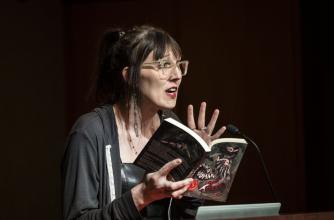
Recipient of a 2011 Lieutenant Governor of Alberta Distinguished Artist Award, Governor-General Award winner, and Banff Centre Paul Fleck Fellow, Robert Kroetsch was one of Alberta's most beloved writers. The Banff Centre is deeply honoured that the Kroetsch family has requested that donations in Robert Kroetsch's memory be made to the Centre: banffcentre.ca obertkroetsch. Photo: George Webber.
On June 28, Alberta lost one its literary giants when award-winning poet and novelist Robert Kroetsch died in a car crash
Not so long ago, on a wet May day, I had a date with Robert Kroetsch. I was a little nervous as I drove from Banff to Robert Kroetsch’s hometown of Leduc, Alberta to interview the “Father of Canadian Literary Postmodernism”. I didn’t know much about postmodern prose, magical realism, or the development of the ‘Canadian long poem’, but in the end, it didn’t matter. Like so many who met him, I had a Kroetschian experience – surprising, inspiring, life-affirming.
I had expected to meet the 83-year-old in his retirement village home, but instead Kroetsch handed me his cane at the door, climbed into my car and instructed me to drive away. “I’m taking you to lunch!” he said. We drove for half an hour through yellow fields glazed with rain, in search of his favourite dessert. “I come here just for this you know,” he told the waitress when we ordered.
“I was very close to my mother,” Kroetsch told me as we tucked into beef stew. “But she died when I was very young. And she wanted me to do something that mattered in the world. It sounds kind of pretentious,” he said, “but I felt I had a kind of ‘calling’. I decided when I was about 17, very young, that writing was what I wanted to do, and I never thought about anything else.”
Kroetsch was born in prairie-town Heisler in the late 1920s. In his boyhood, other farm children accused him of having swallowed a dictionary, so evident was his love of language. “Growing up where I did,” he told me, “there were no stories about the place that I lived in. I had a clean sheet to work on. I could have been silenced I suppose, but instead I thought, ‘Well, I had better make some noise.’” After the loss of his mother, Kroetsch’s motherland of Alberta became his muse. “I spent many years travelling the world,” he liked to say, “but I never left Alberta.”
By the time he was 83 and pouring my tea, Robert Kroetsch had received more literary awards than he could poke his cane at. He had written 14 books of poetry, seven non-fiction books, and nine works of fiction, not including the novella he sent to his agent the day before we met. “I had the idea for it in 1965!” he proclaimed, wielding a spoon. “I was in the foothills near Jasper, fishing with a friend, and he said, just casually, ‘There used to be a town here you know? It was wiped out when the coal mines closed – erased.’ And at the time I thought, ‘What an interesting idea!’, but for 46 years I didn’t know what to do with it.”
“Kroetsch’s work pushed the envelope on reality,” says friend and colleague Steven Ross Smith, director of Literary Arts at The Banff Centre. “His stories are like tall tales – with bigger than life characters. What the Crow Said, for example, features a card game that lasts 151 days. The game goes on surreally long, but then, in the forties, in the prairies, where there was no television or radio, the card game could do that. He takes those kinds of realities, and blows them up. Now Robert is gone. His work was one of his forms of love. He has left me – and everyone – so much to read and reread, to love him back.”
I asked Kroetsch if endlessly hurdling literary boundaries – from fiction to poetry to non-fiction and back again – got exhausting. “It’s the other way around!” he insisted. “I don’t want to do things I’ve done before, they’re boring. Partly I am curious: What’s over that hill? What’s over the next one?” His hands, ever so slightly affected by Parkinson’s disease, emphasised the metaphoric mountain that he woke to walk each day. He smiled. “And partly it is because I have no off switch for my brain.”
As part of his recent Lieutenant Governor of Alberta Distinguished Artist Award, Kroetsch was to receive an October residency in the Leighton Artists’ Colony at The Banff Centre – a place to which he was no stranger. An artist in residency at the Centre in 1947, he also served as faculty for a number of writing programs throughout the 1980s and 90s, and was a Paul D. Fleck Fellow in 2009. “The Banff Centre is a magical place,” he told me. “All these creative people, with energy flowing. I work in my studio, I go talk to the other writers, I marvel at the dancers (those bodies!). It’s a place that lets me be a writer.”
Kroetsch had plans to work on his next book during his stay. “It will be called Caught In The Act,” he said. “I heard somebody say that, and thought, ‘That’s it! That’s my last book right there.’” I remarked that ‘lastbook’ was a big call to make. “It would be a great way to end though wouldn’t it?” he said, looking at me as though I could answer. “Caught in that act.” I asked him what it would be about. “I’ve got no idea!” he said happily. “I don’t even know where to begin! That’s why I want to go to Banff.”
Leaning over, he stabbed the last piece of my cake with his fork. “I’m so glad this place wasn’t shut.”