Archive | Arts RSS feed for this section

Colman Domingo: “Are we dating or are we getting married?”

I first met actor and playwright Colman Domingo two years ago when he was one of a select few writers chosen for the 2011 Sundance Theatre Lab, which had temporarily relocated here for two weeks. He was working on a play called Wild With Happy, writing and workshopping it with a company of actors. In the time since then he’s appeared as an actor in films including 42 and Lincoln, acted in other films that will open this year, including The Butler (starring Oprah Winfrey and Forest Whitaker), and he had Wild With Happy produced as part of the 2012 / 2013 season at New York’s Public Theater (he acted in it there too).

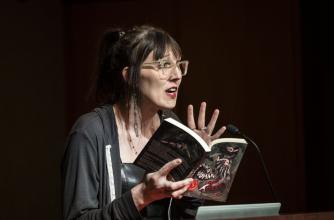
Actor and playwright Colman Domingo, photographed during the 2011 Sundance Theater Lab. Photo: Don Lee.

Actor and playwright Colman Domingo, photographed during the 2011 Sundance Theater Lab. Photo: Don Lee.

I met up with him again, in the Cardinal Studio here, where he was spending a week of intense writing time working on a new commission, The Brothers, for the American Conservatory Theater in San Francisco. I asked him about everything that had happened in those two years between trips to Banff.

“I finished my first draft here, and then it went on to its workshop circuit,” he told me. “After I did the reading here, I think it was the next day I sent the script off to some artistic directors to see if there was some interest in supporting its development and immediately some theatres came onboard, almost with neckbreaking speed. So I had four workshops that were pretty much lined up, and after Banff, it was about three months later that two theatres signed on for productions. So within a year and a half we had our first production, from first conceiving it. I write quickly, and I rewrite quickly, and I love the platform of workshops. I also know when to stop that, because you can live in the workshop forever.”

When Wild With Happy was in workshop at the Public, he invited artistic directors to come and see it. “I told them this would be their one and only time to see it, because I’m not interested in reading this forever. If you come to see this and you’re interested, then you’re onboard for the production journey. I didn’t want it to go into that no-man’s land. I’ve been an actor involved with new works for years, and I know how long that can last. People will read it to death. So it’s like ‘Do you want to commit to it or not? Do you want to commit to this relationship or not? Are we dating or are we getting married?’”

Comments { 0 }

Three Ravens: Summer menu taste drive

CFC130508_DSC2812

Alberta beef tenderloin in Three Ravens Restaurant. Photo: Don Lee.

Dungeness crab, buffalo mozzarella, seared steelhead trout, cinnamon infused black Thai rice, melon and celery salad, onion marmalade, sautéed heirloom spinach, wild mushrooms, Banff Centre grown Mizuna, garlic Brava sauce… My mouth waters reading the menu in our Three Ravens restaurant; visions of delicious dishes brought to life by the creative mix of ingredients, inventive pairings, and visual images our server crafts in my mind. A few of us got to taste some of the new summer menu items recently, and I can tell you each dish exceeds the expectations conjured up by words on a page.

We began with bread and butter, which I only mention to set the mood: this is not your ordinary butter. On the table our server places four different shaped, uniquely flavoured butters:  salted, mango-sambal, sundried tomato-basil, and orange-chive. I love the sundried tomato-basil and I can’t get enough. ‘Remember Monique, you still have a whole meal ahead,’ I try to remind myself.

Continue Reading →

Comments { 0 }

Esperanza Spalding: “There’s a method to the madness as a musician”

The Grammy-winning vocalist and bass player Esperanza Spalding was here in 2002 just before she transferred from Portland State to Berklee College of Music. She was a participant in the Banff International Workshop in Jazz and Creative Music, a session she describes as “a really wonderful balance of concise and results-oriented critique from all these masters who were so genuinely interested in hearing us and working with us.”

Esperanza Spalding (centre) with musicians in this year's Jazz workshop. Photo: Meghan Krauss.

Esperanza Spalding (centre) with musicians in this year’s Jazz workshop. Photo: Meghan Krauss.

I was aware that after finishing her degree at Berklee, Spalding was immediately invited to return as faculty there, so I knew she had lots of experience as both a student and a teacher. When she returned here to Banff in the first week of this year’s Jazz program (the first under new director Vijay Iyer), I spoke with her about teaching, learning, composing, and performing. More of this interview will be in our upcoming issue of Inspired magazine, but this is what she had to say about the confidence gained from good teachers:

There’s some blind faith that there’s a method to the madness as a musician, especially when you subject yourself to the feedback and critique of really advanced musicians. You’re exposing yourself to that because one day you’re going to be at a more advanced level, but you can’t prove it. So through a series of encounters with really inspiring teachers, and clear teachers who, in a loving way, helped me to see the crap I was doing that was in my way, out of insecurity or cutting corners or trying to sound like I could do more than I had actually studied. Those teachers could show you the door out of a pattern, or into a whole new territory of ability. I remember those experiences that would make me want to go home and work on it, above everything else I wanted to do. Someone gives you the lift to keep going.

Comments { 0 }

Learning to juggle with Flyin’ Bob

Flyin' Bob at Banff Elementary School. Photo: Meghan Krauss.

Flyin’ Bob at Banff Elementary School. Photo: Meghan Krauss.

I should start by saying I always wanted to know how to juggle, the key word  being know as opposed to learn or practice.

The week leading up to the first annual Banff Children’s Festival here at the Centre a number of workshops were held at the Banff Elementary School ranging from hula hooping, to storytelling, to Flyin’ Bob. Alongside Mr. Shields’ grade six class I wanted to see Flyin’ Bob work his magic and teach the children circus skills. The plan was just to watch, meet Flyin’ Bob, and talk to the kids about their experiences.

But walking into the gym and hearing the catchy music and seeing the tables of scarves, feathers, balls, and sticks, ranging in colours from pink, purple, yellow, red, green, and blue laid out in front of me, I felt like I was in grade six myself. My curiosity piqued and I suddenly wanted to touch everything on the table and play. “Instead of watching,” Flyin’ Bob tells me, “if you really want to understand the process you’ll have to join in.”

Continue Reading →

Comments { 0 }

Polaris Prize jurors talk shop, not smack

CBC Radio host Katherine Duncan (left), with Polaris Prize director Steve Jordan (centre), and Metro Calgary music critic Lisa Wilton (right) at the Polaris Salon. Photo: Meghan Krauss.

CBC Radio host Katherine Duncan (left), with Polaris Prize director Steve Jordan (centre), and Metro Calgary music critic Lisa Wilton (right) at the Polaris Salon. Photo: Meghan Krauss.

At one point during the recent Polaris Salon here, the prize’s founder Steve Jordan interrupted himself to say, “I’m going to check Twitter to see if anyone’s talking smack.” People laughed, but was it a joke? As Jordan told me later, he’s used to getting nasty comments online, and on the street, from people about Polaris, a prize that rewards $30,000, and the ultimate stamp of approval from Canadian critics, to one Canadian musical act every year. “Sometimes the complaints are legitimate, and we try to adjust to that. But most of the time it amounts to ‘you didn’t pick my band, therefore Polaris hates everything about what I represent’,” he says.

Polaris hosts public forums like this one around the country as a way of explaining how they make their often-controversial decision every year. Jordan, on the panel with jurors Lisa Wilton (Metro Calgary) and Katherine Duncan (CBC Radio), opened the talk with an outline of the process: initially, a couple hundred selected music critics pick what they consider the best Canadian albums of the past year, regardless of ticket sales or genre. After a shortlist of ten titles is tabulated, a smaller group of jurors chooses a winner. Feist, who took the prize in 2012 for her album Metals, likened winning Polaris to ‘getting the Valentine from the right boy.’

Continue Reading →

Comments { 0 }

A word with Ishmael Wadada Leo Smith

Jazz trumpeter Ishmael Wadada Leo Smith (right) with Banff Centre jazz workshop director Vijay Iyer, in the Bentley Chamber Studio.

Jazz trumpeter Ishmael Wadada Leo Smith (right) with Banff Centre jazz workshop director Vijay Iyer, in the Bentley Chamber Studio. Photo: Don Lee.

When he put himself in the shoes of younger musicians, Ishmael Wadada Leo Smith guessed the most exciting part of this year’s jazz workshop would be the “discovery.”

Smith remembers a minor but significant moment of discovery in his musical education. At about 14 or 15 , he was rehearsing with a band. The venue was a dance hall, and a couple of men who had stopped in for lunch knew Smith through his stepfather. The group got up to leave just as Smith’s solo came, and he remembered that they stopped to listen before continuing with their day.

He’s had many years to work on that power of captivation. As a composer, performer, improviser, educator, and trumpeter, Smith has had an incredible career spanning decades. Recently, he was here as faculty during the Banff International Workshop in Jazz and Creative Music, giving talks on subjects like his systemic music language, Ankhrasmation.

But the lecture that seemed to pack the Bentley Chamber Music Studio to its seams was when Smith spoke about his magnum opus, Ten Freedom Summers. One of three finalists for the Pulitzer Prize for Music, the composition addresses pivotal moments in American history. Most are inspired by the American Civil Rights movement, though more recent issues have a place as well. It takes three nights to listen to this ambitious collection of music, which Smith has been working on for 35 years.

In this clip, Smith talks about growing up in Mississippi during this explosive time in American history.

Audio clip: Adobe Flash Player (version 9 or above) is required to play this audio clip. Download the latest version here. You also need to have JavaScript enabled in your browser.

To hear the full piece, check out Podcast Episode 13 on our Soundcloud page.

Comments { 0 }